The Scooter (Part 1)
I moved to New England in 2003, trading the mild Bay Area climate for April snow. Needless to say, I felt some bitterness about this as I’d fled the Northeast years before to avoid this kind of unnatural condition. In response, I did what many adult males do: deluded myself. Specifically, I pretended that having no solution for removing snow magically would prevent snow from appearing. That didn’t work. I passed a couple of winters shoveling Massachusetts snow the old-fashioned way, which did not put me in a better mood about the situation.
Then Nova turned me onto the idea of a gas-powered snow thrower. Her logic was pretty simple: I couldn’t change the weather by pretending it wasn’t bad, so I needed better equipment. I relented, and I admit it: it was probably the best $800 I ever spent. Firing up its engine requires flicking enough switches and pulling hard enough on a starter cord that I feel like I’ve gotten physical. I get to use a choke switch. Who doesn’t love a good choke switch? And it is marvelously loud. Sure it is effective at throwing snow a long distance, but after the other benefits, I almost don’t care. It has changed the way I look at snow. And since we’ve had some winters where the snow hasn’t stopped, I deserve something that can do that for me.
Here’s what this has to do with being a Sandwich Generation father.
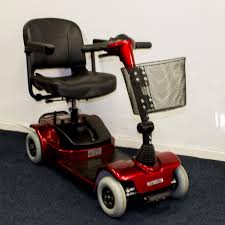
Over the past year, my father’s mobility has declined. It’s a fact. It’s to the point now where he shuffles his feet and not much happens. He has trouble turning. With a walker he can get himself down a hallway, but the clock is ticking on that as well. So about 3 months ago, he asked me to help him buy a motorized scooter to help him get around. Which I resisted. My logic was that once he started using a scooter, he wouldn’t be walking again, which itself would have downstream consequences that couldn’t be good.
I held onto this logic for some time. Like my pre snow-thrower delusion, I felt that I could hold back time a little longer. It’s like trying to wish away blizzards in Massachusetts; you might get lucky for a while, but eventually, the snow emergency is coming. And like that decision, it took someone else to point out that my logic was, in fact, delusional. Actually, this time it took 2 people.
But, in my defense (which is the opening phrase of most indefensible defenses), this is my father we’re talking about. We used to play tennis on the street where I grew up. He helped teach me to swim. He would lift heavy equipment onto his car’s roof as a core part of the way he made his living as a consulting cable TV engineer. I didn’t worship him for these things – we just didn’t have that kind of relationship – but I always knew he was especially strong.
When my mother passed away 5 years ago and I saw her laying there in the hospital, he was the one who kept me from falling over. He was 87. I’ve held onto that as proof that he can defy time, and maybe by extension, that I can too.
Then I thought about what the scooter what mean for him. Right now, he is trapped inside most of the time. With one, he’ll be able to spend a few days outside instead. He deserves to spend more time outside. He gave up his car more than a year ago, and a scooter will be a machine he can control. He deserves more things he can control. And most importantly, he appears to have found a potential girlfriend who lives far away (that is, in a different section of the community where he lives). For all his faults — more on this next time — he deserves to be happy, and I suppose this also means that he deserves a girlfriend.
These are all things that once pointed out to me were so obvious that I wondered what kind of daze I must have been in not to have seen them in the first place.
Do I do this with my children? I like to think I don’t. I don’t pretend that a lack of feminine hygiene products in the house is going to prevent my daughters’ bodies from changing. But then, as with the blind spot I wrote about before, I’m sure I have one here. I look forward to my next discussion on my back porch to discover what it is, and the particular Sandwich Generation delusion about my children that it is hiding.
The Fire Pit

As a Sandwich Generation caregiver, I frequently play the part of responsible one, handling items from substantive to trivial. For my father: medication, financials, negotiating, most shopping, nail clipping (my special favorite), technical support, housekeeping, being a sounding board, and occasionally, son. For my daughters: provider, travel coordinator, technical support (again), chauffeur, male role model, homework aide, designated top shelf reacher, chef, housekeeper (again), swim coach and cheerleader. To my great surprise, I’ve become the responsible adult at work, and where I volunteer, and among colleagues who come to me for advice.
If you live in this mode long enough, you start to believe your own reputation for knowing best. Your constant decision making, and occasional need to appear decisive even though you often have no idea what you’re doing, lulls you into false sense that you do. You also get used to setting the agenda, so when someone tries to influence it, you resist. After all, you not only know have the answers, you are used to having a monopoly on the questions.
I was reminded about how untrue this can be the other night with some friends in front of our fire pit.
We had people over on a Friday night, something I always looked forward to ever since we added a gas-powered fire-pit in our yard. We opted for direct plumbed gas partially on the recommendation of a fellow father of daughters who pointed out to me the very limited control we therefore have over our lives. So true – and this was before my father also arrived on the scene. The least I could do for myself, he recommended, was acquiring the power of fire. How right he was. It makes me happy every time I flick the direct gas line to my grill and think of the propane tanks I am not dealing with.
So last Friday we had a group of friends over to unwind over a few drinks. It was very civilized. Then quite suddenly I started an argument, for no known reason, with a friend of ours. It was like I was watching myself do it and I couldn’t stop. I don’t think I meant a single thing I said, and just kept escalating. Another friend saw this happening and tried to stop me by interrupting and trying to steer me in another direction. I didn’t appreciate her changing the subject, so I started on her too.
I wish I could say that the sudden dark mood was isolated to this one evening, or something physiological like too much stout or too much sugar, or something else I could explain away. Reflecting on it, I know this was not the case.
The previous night, I had shlepped the kids to a meeting that had added incorrectly on the calendar. I was angry, mostly at the situation. Then I ended up taking it out on one of our kids by going passive aggressive, and then basically bullying her into working on something for her upcoming Bat Mitzvah. It was obvious that she was too tired to do it, but the more she retreated, the angrier I got, so the more she retreated. Finally Nova got home and intervened.
Then the night after the fire pit incident, I started in on Nova about the kids’ upcoming B’Not Mitzvah. I’ll spare you the details, but trust me: they were stupid. Any why would I pick a fight about this anyway? We’re hosting an event where almost 200 people want to come from 3 continents, and where my kids’ friends are almost as excited as they are. This is success. I would have traded anything for that when I was a shy, awkward 13 year old. And my father is going to make it. He’ll be almost 92 and he’s going to make it. When he was sick 3 years ago, I was hoping he’d get through the week, let alone to this event.
Over the years, I’ve learned to forgive myself falling down sometimes. This was not always the case. About this week though, I still feel a little ashamed. Maybe I was feeling a little overwhelmed, insecure, and if I am honest with myself, a little intimidated by my friends, my spouse, my father, even my children. They have their whole futures ahead of them and mine slips away a little every day.
And since I am used to being responsible Sandwich Generation father guy, I think I was more susceptible to letting these feelings spiral into something else. Acting the authority figure is a bad habit you can develop in caregiver mode. You are so used to talking that it gets more difficult to listen to other people. I didn’t heed the warning signs and instead railroaded my daughter, my friends, my spouse, and myself.
As caregivers we have selves separate from that part of our identities, and sometimes, those selves are not our best selves. You only hope that you realize what you are doing and get back to being that better self before it’s too late.
The Dead Sea

We just came back from a family trip to Israel, where we spent a night and a day at the Dead Sea. If you’ve never been, the main attraction is the desert setting and water with salt content so high that you float like a cork. When laying on your back it’s quite relaxing, sort of like an especially soft waterbed except with the sun shining on your face. Actually, more like blazing on your face; the high temperature for our visit topped at 106 degrees.
This was Nova’s and my third visit. I won’t say we went reluctantly. But, having been there a couple of times, I remembered it as an old person’s destination. To be more specific, old people who tend to be Russian, overweight, wear banana hammock bathing suits, have hair growing from seemingly unusual places in their bodies, and move very, very slowly. Generally a scene I try to avoid if possible.
And generally I didn’t get the idea of a spa vacation before. Now I do.
First, I think of my father gradually slowing down. In particular, it’s harder for him to get vertical and get around. He’s not getting heavier but it must feel that way. For him, floating in the Dead Sea would be a miracle if I could somehow get him there. I’m sure he would love being weightless just one more time, able to leave gravity behind and just float after years of slow deterioration of his physical abilities. This can’t happen of course; the 11 hour flight home nearly destroyed me (although I did consume 4 movies), whereas I don’t think I could even get him to the airport. Now that I spend so much more time with him, I get the attraction of a place that is warm, slow, and rejuvenating.
The other factor is my shoulder. It’s doing better after I broke my humerus 2 months ago; I can even lift my arm over my head now. It’s the little things. Anyway, I can imagine dipping into a magic elixir that makes the soreness disappear even for just a couple of hours. That’s the Dead Sea for a lot of people. It’s probably psychological as much as physical. I get that too.
As a Sandwich Generation father, I was fortunate enough to be there with my kids. They didn’t remember the water’s sensation from their last visit so this was like the first time for them. They loved it. They floated on their backs, on their fronts, found ways to swim around, and managed not to splash salt water in their eyes. Last time they were not so lucky, and trust me, I don’t recommend it.
They also noticed the old men with strange hair reading their newspapers while floating in the Dead Sea. For them they were something of a curiosity, as they had been for me. For me now, they remind me of someone I know very well, and someone I realize I will someday become.
The Broken Arm


About two months ago, I broke my arm. Not coincidentally, this corresponded with my not posting an entry for about… two months. More on this later.
It was a skiing accident where, in trying to avoid colliding with zig-zagging kids crossing a mid-slope traverse at Sunday River in Maine, I zipped up a hill they’d made by piling up some of the fresh man-made snow. I landed the first jump, telling myself what a hero I was. By the time the word “hero” had entered my brain however, I had started up the second and taller hill and realized that I wouldn’t be landing the second one. I didn’t. Instead I fell and broke my humerus.
I contemplated an entry about recovering from injury at 46 compared to doing so at 26. There’s not a lot of suspense in that though — it’s also not particularly relevant to the Sandwich Generation. What is more relevant is disability.
In particular, because of this injury I suddenly had a great deal of difficulty completing some of the most basic tasks of life. The accident happened on a Friday afternoon, and when I pulled off my sling and tried to peel off my ski clothes on Sunday morning, it quickly became 5 of the most difficult minutes of my life. Putting on a shirt was nearly impossible. Showering when it hurts to move your arm even an inch is a trying experience. Toweling off is worse.
Eating was a challenge as well. Without a functioning left arm hand, I couldn’t cut food. Or really use a knife as a counterbalance to a fork. My most prized kitchen possession is a large Pasquini espresso maker, which I now know requires 2 hands to operate. So do most corkscrews. And bottle openers.
I mention all of this on a blog about being a Sandwich Generation father because it gave me a small taste of my father’s daily struggles with pant zippers, scissors, unopened jars, shirt buttons, slipping on shoes, getting into cars, and the million or so items of basic everyday living that challenge him. I used to get angry when he failed to change his shirt after spilling soup on it. Now I understand better why he doesn’t bother – it’s a lot of work. More than that, it’s frustrating. You struggle to reach the buttons and remember that it used to be an afterthought to slip them into the buttonholes. You have trouble simply crossing the room and flicker back for a moment to playing tennis on the street in front of your house with your sons.
I visited him one evening a few weeks ago to help with a television emergency. Yes, there is such a thing. He was in bed when I arrived and while I spent about 15 minutes diagnosing and fixing the issue, he was barely able to get out of bed, slip on his robe, put his dentures back in, and wander outside to the living room. I realize now how much time and energy he’s invested before I come on the weekends to shower, dress and shave.
There’s more than one reason that I haven’t written for a while, but with my left arm in a sling, I found it difficult to type. This also made it difficult to work since a large part of my living depends on how effectively I can tap at a keyboard. Truth be told, I did not adapt quickly. Adapting also takes a lot of energy and because of the pain, I was tired a lot. The pain was constant, but almost more important: it was draining. I suspect that my energy level was more like someone who is 86, not 46. Of course, my father hasn’t been 86 for some years now, so even with this experience, I can only imagine what that must feel like.
On the bright side, my children – the other side of the sandwich, if you will – took responsibility and helped tremendously, especially with dishes. And, in a moment of which I am particularly and perversely proud, they also helped with a bottle opener. Perhaps no beer has ever tasted as delicious as that one. Another small victory for a Sandwich Generation dad with a broken arm and a long recovery ahead of him.
The Capital Letters
When I arrive on Sunday mornings to my father’s place, he’s usually sitting in his old chair in front of his heavy, worn wooden desk. It’s old enough that the drawers either droop or don’t open without herculean efforts. A small spiral notebook sits on the right side, his iPad in the front and the inbound mail on the left. The new in the middle, the old on the right and left.
This notebook contains the list of my tasks he’s stored up over the course of the week for me to address during our regular sessions. It’s a consistent set of technical issues, household annoyances, financial questions, and the occasional personal care request. Apparently one core skill you need as a Sandwich Generation son is the ability to give pedicures. Always these tasks are written in capital letters. My father has always preferred capital letters.
In his office in my childhood home, the one where the desk used to live, he mounted a posterboard on his wall to show upcoming projects. He was a one-man consulting engineer who would pile himself and his sophisticated electronic equipment into a faux-wood paneled station wagon and trudge off to faraway cities. He’d test television signal levels to help design or improve antenna or satellite towers; two of then loom to my right when I drive down Route 9 toward Newton.
The posters hung in landscape position with 3 columns and maybe 10 or so rows. He’d show the date, the city, and a few other tidbits about the job. All written in capital letters. I remember like it was on the wall of my house today. Over the years, those posters piled up behind him filing cabinets – those stayed behind when he left the house 2 ½ years ago – like a history of his career, his marriage, the life he created for my brother and me of a father on the road.
I’m remembering this now because last weekend an inbound direct mail piece from Carnival Cruises prompted me to suggest that Bermuda would be close enough to visit if he wanted. He shook his head and started recounting the many reasons he couldn’t. One piece of evidence he offered up about his decline was the trembling in his hands. And t’s true – they do tremble a little. Then he held up the notebook and said, “See – I can only write in capital letters.”
That’s true now – but it was sort of true then. Same for the unusual way he stands up, using his arms to lift himself up instead of his legs. He’s always done this and it drove my mother to distraction. Now he notices it. He’s never had good hearing. For years it was because “you all mumble!” Now he recognizes it.
So as middle age has overtaken me, I too have started to look for my signs of my own physical decline. When you look, they are everywhere. My vision up close isn’t the best anymore. On many nights, my energy runs out long before I think it used to. My powers of concentration are deteriorating. And my handwriting has become totally illegible. Or at least, that’s what I thought until the journals that I kept when I was 16 disabused me of this notion.
In the moment in front of the familiar old desk, I resisted the urge to talk my father out of his sentiment. That would have been unrealistic; he is almost 92 after all, and of course he’s declining physically. Or put another way, some of the tendencies that have been there all along are more pronounced in him. And in me.
His letters are in caps, while in my notebooks – new and old – they are in a weird middle area between caps and lower case. That’s not new though. It was there all along.
The 6pm Dinner

When my father first moved up here 2 years ago from my childhood home in New Jersey, one feature of his community that my brother and I loved was the scheduled dinners with the same people. The idea was: it would force him to substitute his worn bathrobe for actual clothing, get some minimal exercise by walking down the halls. He’d have to interact with people in the elevator on the way. He would sit at a table with the same people with whom he’d inevitably becomes friends. He’d have to engage in conversation to keep him sharp. Plus we’d know he was eating well. As an added bonus, if he didn’t show up to dinner, they’d know and quickly figure out why. It seemed like a dream.
Mostly that’s because it was. That’s a system designed for Sandwich Generation fathers like me, not the actual people involved.
My father escaped this system by accident. Literally – his incontinence is what broke him free. Once his community’s director started indirectly referencing that “others” were complaining about his smell at meals, even the ones he hadn’t attended, his response was to stop coming and order dinner to his place instead.
Here’s what this means. Now, my father calls down at whatever time of day he feels like and has lunch and/or dinner delivered to his room. He gets room service every day! Every day! When I described it to my kids, it blew their minds because I’ve described hotel room service as a treat for special occasions. Sometimes he finishes the whole meal, but often, he sort of snacks on it all day. Which itself is healthier. He’s not that hungry late in the day so he orders earlier. Also healthier.
Thanks to his incontinence problem and his DVR, for the first time in 50 years he is also freed from the constraints of the clock. He might love this most of all.
We ate my childhood dinners at 6pm on the nose, with the dinner bell (yes, a dinner bell) at 5:58. My mother always blamed this rigidity on my father who expected things a certain way. But now I am learning that this (too) wasn’t exactly true. She was always one to complain about something, and blame it on someone else while all the while she had wanted to do it in the first place. So it was with our 6pm dinners, it turns out, because she wanted to watch the 6:23pm weather from the local Philadelphia station, the 6:26pm weather from New York, and then World News Tonight (first with Frank Reynolds and then Peter Jennings).
They did this every day. Apparently my father hated it. So being freed from the 6pm dinner seating at his place is another revelation that in hindsight is obvious.
Now he has freedom of his own schedule and his own place and his own meal choices and the safety net of Sandwich Generation sons who can understand that their notion of meals was all wrong. Well meaning, but all wrong.
The Hiatus

For the second time in about a year, I didn’t write a blog post for a while. A lack of drama partially caused this; inspiration is difficult to mine from flawless visits to a parent who is healthy and mentally sharp, or family vacations taken without incident. Some of it stemmed from focusing on some of my own issues that had nothing to do – well, almost nothing – with being a Sandwich Generation father.
Specifically, my career took a weird left turn last summer. I went from frantically busy to idle almost overnight. Actually, it wasn’t overnight. It was even faster than that.
First, I treated myself to about 6 weeks of not really thinking about it; after all, it was August, a time when much of Boston basically shuts down. And I hadn’t enjoyed a month off in the summer since I finished business school and been married sixteen years ago. Later, this particular hiatus was filled with soul-searching about the sudden feeling that the developing career narrative I’d built for myself had been an illusion. At 25 this is a fine discovery, maybe even at 35. But at 45 it came as quite a shock.
Of course I am a Sandwich Generation father, which colors everything, including this particular bout of introspection. What I remembered as the shock passed is that while family commitment and career achievement aren’t locked in a tug of war, it’s certainly a delicate balance. Most people – men especially – feel like this is the age where they have to hit the gas on career because they are in their prime earning years. That’s probably true. It’s the first time I’ve noticed the lower energy level in most people 10 years older than I am. And the moments do come when I find myself jealous of the many people who surround me who have (or, spend) more than I do.
What’s also true for me is that my father is almost 92 and lucid, and maybe not for much longer. My kids are 12, and still like me and still need me. Maybe not for much longer. My marriage, my community, my spirituality – all of these both demand and give me energy. They all define me.
I know from more than 2 years of balancing them that at any given time I need to be able to hit the gas on either the personal or the professional. Which means — I have to set myself to be able to do that. I can’t floor it on either for very long in a row because the other always intervenes.
Fortunately – it’s January now, so the lure of unemployment is less strong – I’ve found something that works. More on that in another post.
As for the blog hiatus – they say with writing that the hardest thing is to start. So it was for this next round of blog writing; it took me weeks and several false starts. Now that I am into my new (flexible) routine, I have a sense of when I’ll have pockets of time to think and to write, so will be more consistent. One thing I know is that real-life hiatuses are hard to come by in the reality of a Sandwich Generation father.
The Senior Moment

So Sophie bounds downstairs one morning last week, ponytail bouncing, and carrying a pair of underwear. She stops at the entrance to the kitchen and looks down at her hands as if in disbelief. Then she scrunches her face, and says “These aren’t socks. I meant to bring socks.” She turns around and heads back upstairs.
And in my mind I think: senior moment.
It was gratifying to seeing it happen to someone so young. Increasingly I find myself heading for the freezer and midway having to stop and remember what for. My father suffers from this almost less than I do; he has eliminated most clutter from his brain space so while (like the rest of us, let’s be honest) he repeats stories, usually he doesn’t find himself mid-stride without quite recalling why. And he remembers elements of his own childhood, and mine, with precision that’s almost startling. A few weeks ago I mentioned a childhood trip to the Outer Banks and he replied, “That was either 1973 or 1977.” He recounts details of his escape from Hungary almost 60 years ago like it just happened.
A while ago I wrote about feeling most times in this Sandwich Generation father experience that the glass half full. It’s true. The glass is half full any day when your 12 year-old daughter appears a little more forgetful than your 91 year-old father. Even more so when you make it to freezer without stopping to wonder why.
The Observation

Because it’s mid-Yom Kippur and I am in the part of the Sandwich Generation with only one parent, I am thinking about my mother today. Last night at services I looked to my right at my children and flashed briefly to just how much they’ve grown in the 4 years since she passed away. If she could observe them, she’d be proud of them. Maybe she would be a little proud of how I’ve done as a father with, let’s face it, no formal training whatsoever.
Over the choir’s chanting, I flashed to a recurring dream I’ve had over the past couple of years. I am a recurring anxiety dream kind of person. My usual standards are (a) I’m trying to make a plane but every step just seems to take a lot longer than usual, like I’m running in molasses, (b) I somehow didn’t study all semester and the test is in 24 hours or, another variation on this topic, (c) I’m back in business school and skipped most of last semester, so this semester I am really in trouble if I want to graduate. Oddly, I recently conquered (c); somehow mid-dream I’ve been remembering that Stanford was a zillion years ago and that this can’t be reality.
In this particular dream, I’m standing in the a dream-altered version of the kitchen of my childhood home. It is smaller, more cluttered (which you would not think possible if you ever visited my mom’s kitchen), the light a little more slanted and muted. My mother is alive. Her death turns out to have been a big medical mistake and she’s back. In the dream this is reality, not realization; as I walk into the house, I accept that this new version is just how things have been for some time now.
“Reality” also means that my father has moved back in with her into my childhood home and they have fallen back into the pattern where as a unit, she is caring for him.
I think I flashed to this because having pondered how proud my mother would be of her grandchildren, I know she would be amazed at my father. It’s hard to remember the days before he became a widower and in his late 80’s managed not only to survive but to carve out a life. But in the dream and last night in the synagogue, I realize that if she were still alive and could see it, it of course wouldn’t have happened. By observing it, she would change it. It’s the human application of the Heisenberg principle from physics: observing momentum at the atomic level alters it.
In the case of my parents, this maxim holds. My father told me a story a few weeks ago about a planned Alaskan cruise that they canceled abruptly the morning of their flight to Seattle because she suddenly didn’t feel well. Around and observing her constantly he didn’t divine what I surmised not long after she passed away: she spent the last several years of life struggling with illnesses, with anxiety, suffering in near silence. It was just like her to make you worry more about her more by telling you not to worry about her. Now, with distance, he recognizes that she must have spent weeks fearing having to let on to him that she wasn’t well enough to make that trip. Which then altered what happened.
As a caregiver, observation frequently leads to corrective action. It has to. As a parent, there is a balance is between observing our children’s reality and stepping in, no matter how good the intentions, to change it. Knowing when to do which is something for which, as previously mentioned, I did not receive formal training. I must have skipped that semester at Sandwich Generation dad class. Now as in my dream, I suppose I am in some trouble now as my daughters edge closer to adolesence. At least now I know to watch out for doing both at the same time.
The Moment

My brother and family visited from California last weekend. Traveling is challenging for them with a 6 year-old, a 3 year-old, a 6 hour flight and 3 time zones. But because my father lives here and is no longer mobile enough to travel, they make at least one journey east every year. This year the calendar page for September 13th said “Rosh Hashanah”, and thanks to a lucky series of sports scheduling and well-played tennis by Roger Federer and Novak Djokovic, it also marked the US Open men’s final.
When I was growing up, my father, brother and I would watch Wimbledon and the US Open religiously. My father would yell at the TV and criticize the players for all of the “stupid” things they were doing. It was a variation on a common theme in my house. Anyway, if I close my eyes I can imagine Borg and McEnroe when I was 10, or Steffi Graf and Martina Navratilova when I was 18, or 1996 Graf-Vicario final we watched in Atlanta while visiting my brother. And I remember watching the French Open with the 2 of them when my father was in the hospital in Princeton beating back post-colonoscopy complications when he beat colon cancer.
So in August this year, when I noticed how the calendars lined up, I started rooting for a #1 vs. #2 matchup at the US Open. And then the players in the rest of the draw acceded to my wish and it happened. It was as though destiny had one more epic tennis-watching session in store for the 3 of us. My kids, who I have indoctrinated into becoming Federer fans, were ready as well. My Sandwich Generation dad moment in front of the Flushing Meadow court.
Except that a rain delay pushed the match back from 4pm to almost 8pm, late enough that my father couldn’t watch with us, we had to serve dinner instead, and my kids were occupied with my nieces. It was a moment that was not to be.
I mention this because my kids have moved into pre-teen mode and I can hear the clock ticking down their last few days as willing inhabitants of our home. My father likely doesn’t have many US Open finals left in him. The moments I have together with them take on a fierce urgency, each opportunity feeling more precious than the ones before it. This is the benefit of mortality, I suppose. It forces you to appreciate and savor the glimmers you get.
This is one reason that, unlike my brother, I am not a frequent videographer. Maybe this is a mistake. My philosophy is that I would rather be in the moment than observing it, and I have learned about myself that I don’t do both well.
Most moments I have with my father now aren’t scripted calendar-aided events. Yes, my kids have their B’Not Mitzvah celebration coming up and with any luck he’ll be there. But I am thinking of the pauses amongst the list of chores I perform at his place when he stops, thinks, and begins a sentence with “You know, I never told you….” It’s not the notes that make the moments. It’s the empty spaces between them. The same goes for my kids. It’s the small remarks, the impromptu dances they choreograph, the stories they offhandedly tell us when we’re playing cards and everyone has their guard down. Those are the moments I already miss.
I checked with Google and learned that Rosh Hashanah 2016 is in early October, so there’s no US Open final during the holiday. Maybe it’s just as well. The 3 of us missed watching a pretty compelling final, but we’ll always have the 4th set tiebreak of the 1980 Wimbledon final. A great moment that, at the time, we didn’t see coming.


 The Sandwiched Man
Recent Comments