
The Flashing Lights
Sometimes the smallest things remind you of where you’ve been, where you are, and where you’re going.
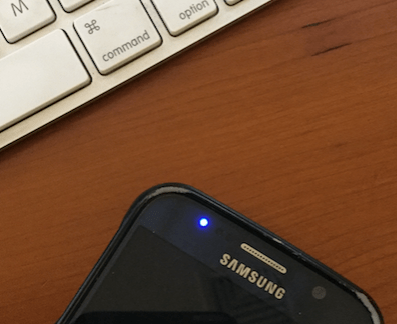
My phone has a light that flashes different colors based on what kind of alert I’m getting. Blue for most things, including text messages. Green for certain alerts, including Facebook. Yellow for notifications from different apps. Red for a charging battery. With one quick glance I know what kind of message I’m getting and whether or not I have to respond, without even seeing what it is.
It’s a rainy Sunday and before I left for my weekly visit with my father, I reached out to 2 friends whose situations I know all too well. One lost her mother 10 days ago after an unexpected and fast decline. She is in the part of mourning a parent where you just start to feel like you actually someday might feel like yourself again. You do a workout, take a trip to the mall, laugh with your kids at a TV show to gain a small shred of normalcy. Through your grief you look up and can see the surface of the water; while you are happy you can see it, it is so far away. I didn’t have her phone number, so I messaged her on Facebook. A green light if she responds.
Then I texted another friend who is at the start of moving a recalcitrant and newly compromised parent to Massachusetts from an unsold house in another state. She is in the part of becoming a caregiver where you are just trying to survive it. You haven’t had time yet to consider how much a part of the Sandwich Generation you are about to become, or that your reward for surviving the upcoming months of sprinting will be years of trudging ahead. You don’t have the time or inclination to look for the surface of the water. You are just trying to get boxes unpacked and keep your newly fragile parent from falling apart from the shock. A blue light if she responds.
On my way, I found myself at a red light, and looked down at my phone. Flashing blue. I disappeared in my head to a moment in 2013 just after my father had moved here. It is late on a fall Sunday afternoon and I am over at a friend’s house after dropping something off. He, his wife, and another couple – the same woman who is turning my phone’s light a flashing blue – are into their second bottle of cabernet laughing around the kitchen table about the previous night’s party. I feel a wave of isolation and jealousy wash over me as I instead am rushing over to my father’s place to deal with the latest disaster brought on by his never-ceasing C Diff attacks. They are preoccupied in their conversation and it hits me that I live in a different world from them, and that I can never go back.
I arrived at my father’s, unplugged my phone from the car charger. Flashing green. Now I am thinking about the cabinet full of the COPD medication my mother didn’t take. She never exercised, continued to sneak cigarettes for years after her quadruple bypass, drank endless cups of coffee to get up and swallowed valium to take the edge off. She too had a fast decline and I can’t help but wonder if it didn’t need to be so fast.
Blue. My uncooperative and cantankerous father is exiled from his post-hospital rehab center, so I have to scramble to move him back into the house long enough for my brother moves to move him to Massachusetts. Green. I completely fall apart when I see my kids for the first time after she’s gone. Blue. My brother has only 72 hours to extract my father from our childhood home and reduce lifetimes of memories into what he can fit into a moving van. Green. I climb into my car a week after my mother has passed away and try to muster the strength to drive back home to Boston from New Jersey. I don’t know if I can do it but I know I have to try.
Blue. My father is happy, healthy, and thriving at 92. Green. My mother escaped a long, slow decline, and my daughters have only sweet memories of her. Where I am today is very different from where I was. I am grateful.
Earlier this week I saw flashing lights of a different color in front of the house next door: red ones from a fire truck. They are coming more and more these days as my neighbor has given up her battle with brain cancer that she is about to lose. I have been blessed as my father has beaten one life-threatening condition after another. They remind me though that someday, somehow, his luck is going to run out, and with it, mine.
Sometimes the smallest things remind you of where you’ve been, where you are, and where you’re going.
The Fire Pit

As a Sandwich Generation caregiver, I frequently play the part of responsible one, handling items from substantive to trivial. For my father: medication, financials, negotiating, most shopping, nail clipping (my special favorite), technical support, housekeeping, being a sounding board, and occasionally, son. For my daughters: provider, travel coordinator, technical support (again), chauffeur, male role model, homework aide, designated top shelf reacher, chef, housekeeper (again), swim coach and cheerleader. To my great surprise, I’ve become the responsible adult at work, and where I volunteer, and among colleagues who come to me for advice.
If you live in this mode long enough, you start to believe your own reputation for knowing best. Your constant decision making, and occasional need to appear decisive even though you often have no idea what you’re doing, lulls you into false sense that you do. You also get used to setting the agenda, so when someone tries to influence it, you resist. After all, you not only know have the answers, you are used to having a monopoly on the questions.
I was reminded about how untrue this can be the other night with some friends in front of our fire pit.
We had people over on a Friday night, something I always looked forward to ever since we added a gas-powered fire-pit in our yard. We opted for direct plumbed gas partially on the recommendation of a fellow father of daughters who pointed out to me the very limited control we therefore have over our lives. So true – and this was before my father also arrived on the scene. The least I could do for myself, he recommended, was acquiring the power of fire. How right he was. It makes me happy every time I flick the direct gas line to my grill and think of the propane tanks I am not dealing with.
So last Friday we had a group of friends over to unwind over a few drinks. It was very civilized. Then quite suddenly I started an argument, for no known reason, with a friend of ours. It was like I was watching myself do it and I couldn’t stop. I don’t think I meant a single thing I said, and just kept escalating. Another friend saw this happening and tried to stop me by interrupting and trying to steer me in another direction. I didn’t appreciate her changing the subject, so I started on her too.
I wish I could say that the sudden dark mood was isolated to this one evening, or something physiological like too much stout or too much sugar, or something else I could explain away. Reflecting on it, I know this was not the case.
The previous night, I had shlepped the kids to a meeting that had added incorrectly on the calendar. I was angry, mostly at the situation. Then I ended up taking it out on one of our kids by going passive aggressive, and then basically bullying her into working on something for her upcoming Bat Mitzvah. It was obvious that she was too tired to do it, but the more she retreated, the angrier I got, so the more she retreated. Finally Nova got home and intervened.
Then the night after the fire pit incident, I started in on Nova about the kids’ upcoming B’Not Mitzvah. I’ll spare you the details, but trust me: they were stupid. Any why would I pick a fight about this anyway? We’re hosting an event where almost 200 people want to come from 3 continents, and where my kids’ friends are almost as excited as they are. This is success. I would have traded anything for that when I was a shy, awkward 13 year old. And my father is going to make it. He’ll be almost 92 and he’s going to make it. When he was sick 3 years ago, I was hoping he’d get through the week, let alone to this event.
Over the years, I’ve learned to forgive myself falling down sometimes. This was not always the case. About this week though, I still feel a little ashamed. Maybe I was feeling a little overwhelmed, insecure, and if I am honest with myself, a little intimidated by my friends, my spouse, my father, even my children. They have their whole futures ahead of them and mine slips away a little every day.
And since I am used to being responsible Sandwich Generation father guy, I think I was more susceptible to letting these feelings spiral into something else. Acting the authority figure is a bad habit you can develop in caregiver mode. You are so used to talking that it gets more difficult to listen to other people. I didn’t heed the warning signs and instead railroaded my daughter, my friends, my spouse, and myself.
As caregivers we have selves separate from that part of our identities, and sometimes, those selves are not our best selves. You only hope that you realize what you are doing and get back to being that better self before it’s too late.
The Capital Letters

When I arrive on Sunday mornings to my father’s place, he’s usually sitting in his old chair in front of his heavy, worn wooden desk. It’s old enough that the drawers either droop or don’t open without herculean efforts. A small spiral notebook sits on the right side, his iPad in the front and the inbound mail on the left. The new in the middle, the old on the right and left.
This notebook contains the list of my tasks he’s stored up over the course of the week for me to address during our regular sessions. It’s a consistent set of technical issues, household annoyances, financial questions, and the occasional personal care request. Apparently one core skill you need as a Sandwich Generation son is the ability to give pedicures. Always these tasks are written in capital letters. My father has always preferred capital letters.
In his office in my childhood home, the one where the desk used to live, he mounted a posterboard on his wall to show upcoming projects. He was a one-man consulting engineer who would pile himself and his sophisticated electronic equipment into a faux-wood paneled station wagon and trudge off to faraway cities. He’d test television signal levels to help design or improve antenna or satellite towers; two of then loom to my right when I drive down Route 9 toward Newton.
The posters hung in landscape position with 3 columns and maybe 10 or so rows. He’d show the date, the city, and a few other tidbits about the job. All written in capital letters. I remember like it was on the wall of my house today. Over the years, those posters piled up behind him filing cabinets – those stayed behind when he left the house 2 ½ years ago – like a history of his career, his marriage, the life he created for my brother and me of a father on the road.
I’m remembering this now because last weekend an inbound direct mail piece from Carnival Cruises prompted me to suggest that Bermuda would be close enough to visit if he wanted. He shook his head and started recounting the many reasons he couldn’t. One piece of evidence he offered up about his decline was the trembling in his hands. And t’s true – they do tremble a little. Then he held up the notebook and said, “See – I can only write in capital letters.”
That’s true now – but it was sort of true then. Same for the unusual way he stands up, using his arms to lift himself up instead of his legs. He’s always done this and it drove my mother to distraction. Now he notices it. He’s never had good hearing. For years it was because “you all mumble!” Now he recognizes it.
So as middle age has overtaken me, I too have started to look for my signs of my own physical decline. When you look, they are everywhere. My vision up close isn’t the best anymore. On many nights, my energy runs out long before I think it used to. My powers of concentration are deteriorating. And my handwriting has become totally illegible. Or at least, that’s what I thought until the journals that I kept when I was 16 disabused me of this notion.
In the moment in front of the familiar old desk, I resisted the urge to talk my father out of his sentiment. That would have been unrealistic; he is almost 92 after all, and of course he’s declining physically. Or put another way, some of the tendencies that have been there all along are more pronounced in him. And in me.
His letters are in caps, while in my notebooks – new and old – they are in a weird middle area between caps and lower case. That’s not new though. It was there all along.


 The Sandwiched Man
Recent Comments