
The Song for Another Time

At the risk of alienating more than a few readers, I have a disclosure to make: I am a huge country music fan. It’s true. It’s been almost 25 years now since someone played Mary Chapin Carpenter (who went to my high school, actually) for me and I was hooked.
One of my recent “songs on repeat” is from a band called Old Dominion. It’s called “A Song for Another Time”. It’s about a relationship which is great, but is going to end, and soon. The idea is that we should enjoy it now, and feel the sadness later. This is a common country music theme, I know. To make the cliche worse, as if it could get worse, the descriptions of how amazing things are, and how sad they will be, are just the titles of songs strung together. Brown-Eyed Girl. Sweet Caroline. Always on My Mind. I’m So Lonesome I Could Cry. You get the idea. Trust me: no one will be writing articles about this tune 50 years from now about how it changed music.
But I am hooked on this song anyway. It captures something in the way that only music can. Like many of you, I have lived almost this exact scenario in a relationship before. (As an aside — I could do a whole other blog on those moments in relationships, of all types, when you know it’s all going to change, either one way or the other. Comes down to only a few and they always stick with you.) And as a Sandwich Generation father, there are moments when I feel like I am living it now.
My daughters just turned 13 in June. I’ve been told by countless parents that the journey from here to 16 is fraught with peril. Occasionally I can see that future, but not today. Today my kids still think I am funny and smart, and mostly like being around me. We have fun together. They make just about anything I’m doing more fun. They still have some innocence and at the same time show flashes of wisdom that make me shake my head at how amazing they are going to be as women.
After the first day of school, I took Sophie to Five Guys and we just hung out and ate dinner together and talked about our days. It was simple, and sweet, and lovely.
My father too is in one of these phases where I recognize that things are about as good as they are going to get. There are more bad days than there used to be and some things that I do for him make me a die a little every time. I wish I didn’t feel that way, but I do. And yet I know the glass is still half full. Many blogs about caregiving are written by women, mostly older than I am, who are caring for very sick parents who need help with the basics, who can’t remember who they are, or are fighting terrible diseases. Much of my time as a Sandwich Generation son is spent just talking, or fixing modest technical issues with his iPad. Last Sunday afternoon we hung out and watched the US Open final, like we have for almost 40 years now. It makes me feel like a kid again and so happy that I still have my father. It was simple, and sweet, and lovely.
In the back of my mind, I know different days are ahead. The moments will come in those relationships when I know they are going to change. As the lyrics go, though – that’s a song for another time.
The Stuff Catalog
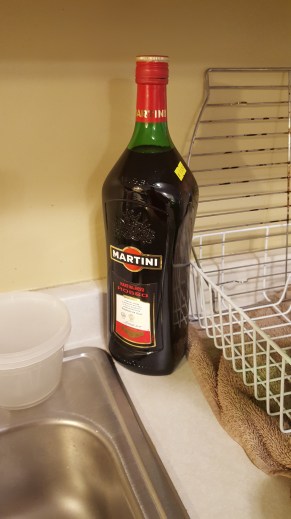
A brief departure from introspection to a discussion of some nuts and bolts. Specifically, for those of you embarking on the journey of caring for an elderly parent — whether or not you are sandwich generation — I thought it might be helpful to catalog some of the gadgets, devices and doohickeys that help make my father’s independence possible. Some of these were carefully considered and do perform the function that my brother and I hoped they would. Some are useful even though we didn’t expect it. And others… well, fails happen.
In no particular order…
Old Backup Hard Drive
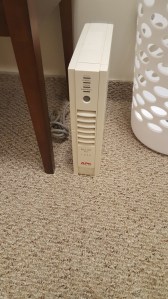
We have this stashed by the front door. It’s a refugee from the Rube Goldberg contraption IT setup my father once had. Useless in his iPad world, it makes a great doorstop.
Sony Wireless Headphones
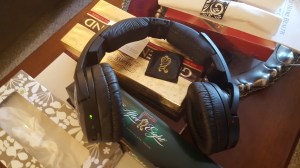
Because my father’s hearing is not the best (and never has been – see The Capital Letters for more on this), he used to blast the TV, with predictable results. These headphones connect to the back of the set and then project wirelessly. Everyone is happier.
“Lifeline” monitoring system
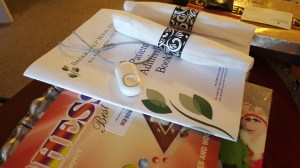
It’s typically assumed that the elderly need a “panic button” (a la, “I’ve fallen and I can’t get up.” My father has one that’s provided by his community. He never, ever wears it. Amazing for someone with such a strong survival instinct.
The Coffee Table
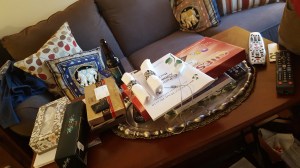
When he moved here 2 ½ years ago, my family and I went to local mega-chain Jordan’s Furniture to furnish his apartment. Literally every single thing we bought was wrong. Here is a really cool coffee table where the top pulls up to reveal storage inside. Totally unpractical. Other misses include the uncomfortable wooden chairs (because now you need a pad – and my father has incontinence issues) without arms (because he can’t stand without using his arms to lift himself), the nice-enough wooden table that he coated with stains and crumbs within 2 weeks and the small table lamps which he can’t operate.
Campari
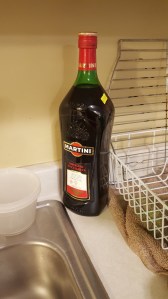
Somehow my dad discovered the pleasures of having a drink here and there. He’d never done this before. This is his go-to, roughly once a day. The apartment is always stocked.
Jack’s Abby Smoke and Dagger

This is for me. Sometimes as a caregiver you need something to get you through your visits. Also notice the cologne next to my beer bottle – my dad uses this to mask his scent when necessary. It somewhat works. Somewhat.
Two-sided covered hamper
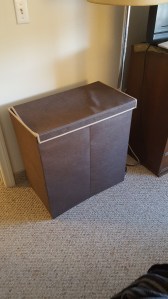
When you invest in your parent’s laundry needs, get the biggest hamper you can find and make sure it has a lid. The lid should be easy to open and easy to close so that it stays closed. Enough said there.
Grabbers

Buy more than one. This is the one that lives in my dad’s shower. On a side note: your parent is going to leave things in places and in conditions that you might not. This thing is metal and is always wet. That’s just life. Move on.
Batteries
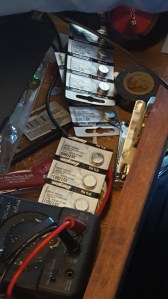
One of the great challenges for the elderly is changing batteries. (Another is figuring out how to make the cellphone work – that’s why my father doesn’t have one anymore. And what exactly does he need it for?) One reason the headphones are so great is that they charge on a stand. If you are a product designer and you think that people over 80 might be a target market, make sure that your product recharges. These are for his Apple TV remote; we have another set for his hearing aid.
Photo albums
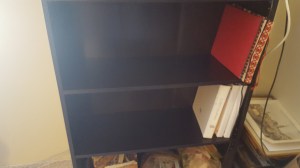
This empty shelf is where his photo albums used to be. We had them scanned at GoPhoto instead. They’ll take your photo albums and turn them into high quality electronic pictures (you know, the type we now take for granted because there’s always a high resolution camera in your pocket.) Now he can view pictures on his iPad and Apple TV, and share them. In an album, they’re hard to access.
The Hammer
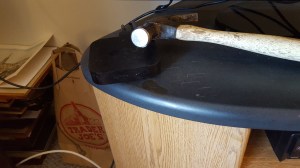
Sometimes he needs a hammer – but most often, it’s what keeps the tension from the network cables from pulling his AppleTV off the shelf. No uni-taskers.
Wireless Hub

My brother came up with this innovation. Since my father relies on the Internet for pretty much everything, and cable companies can’t distribute equipment that doesn’t need to be reset constantly, it had to be easy to do. More than 2 years in, we moved the cable modem to a shelf he could reach easily and tuned the unit so that the cables and power switch were in front instead of the back. File that under “Why didn’t we think of that earlier?” Caveat: this trick has a lifespan because eventually, an elderly parent won’t remember to how to use this, or won’t listen when you describe it to them. This recently happened and believe me, it sucks.
Obi (Voice over IP) box

Many posts ago (Top Tech Tips for the Sandwich Generation) I wrote about switching to Google Voice and an adapter so that we could use it with a regular phone. This way, we can get a copy of my dad’s voicemails, which occasionally include something from his doctor’s office that someone should respond to. My dad relies on home visits so scheduling them in critical. This is the adapter.
Dropcam

We have it pointed at the front door so that we can see his coming’s and going’s. No, we never just watch this (imagine C-Span without the excitement). But if he is getting into a taxi to meet us somewhere, now we know when he actually left. Also helpful for seeing when the aforementioned home medical visits really happened.
Schedule Board
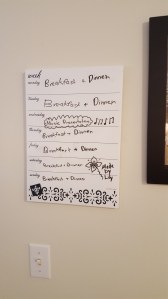
My daughter Lily wrote this schedule on here. I love seeing her handwriting (and flower – she’s always loved flowers) and remember how earnestly she wrote it. She’s always been so eager. Of course, that was 2 years ago because we don’t really use this. Not practical, especially for someone who doesn’t really use his kitchen table that much.
Glade Air Freshener
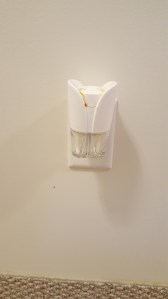
During the worst of our incontinence challenges, these were lifesavers, especially because my father doesn’t naturally open the windows. Now we use them less as they can be pretty overpowering. Sometimes that’s what you’re going for though.
Industrial-strength walker
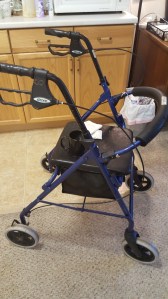
The picture sort of says it all – it also makes a handy surface for holding your most important stuff. It’s hard to fold and bulky but I think of all my father’s physical possessions, this might be the one that he’s most convinced he couldn’t live without. Even now that he has a scooter, it’s a security blanket for when he is out and about.
Kitchen armchair
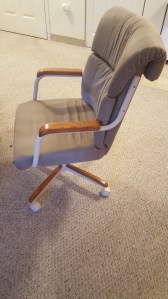
This is a new purchase – it’s meant to fix the problem we created by buying the wrong chairs the first time. My father has no power in his legs, so he has to rely on his arms to stand up. Close… but also wrong since the height is not adjustable. Find one that is. Now we have C-clamps on his kitchen table so that he can pull himself up instead of pushing off the table, which is close to breaking.
Coffee Maker
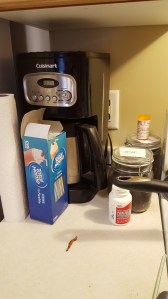
My father used to invite friends over for coffee, so we brought this up from New Jersey. Then I went to Dunkin and stocked him up so that he could do the same in Massachusetts. That’s the original coffee I bought more than 2 years ago. The jars have never been moved. Literally. I actually tried to remove the ‘decaf’ jar from the counter a few weeks ago and it’s become stuck to the counter somehow, so I couldn’t budge it. When we lose his security deposit someday, this will be why.
Panasonic Phone

Large buttons, high volume, loud ring and easy to use. Perfect. We bought 5 handsets (by his TV chair, on his desk, at the dining table, by his bedside and in the bathroom).
iPad
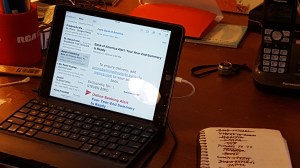
The essential tool for the connected elderly.
Lift chair

Maybe the best thing we ever bought him.
Toaster
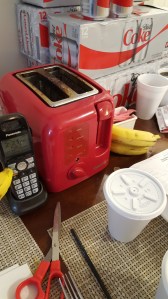
What’s not interesting about this is the toaster itself – it’s that he asked to have it on the same table where he eats. (Note: I know that’s “interesting”, not interesting.)
By the time he used to shuffle across the room from the kitchen, his toast would be cold. So while now there are crumbs in multiple places in the apartment – something else I’ve had to learn to get over – now he’s able to avoid this problem. He’s pretty proud of himself, and sometimes building confidence in your elderly parent is more important than the thing that made them feel that way.
Also notice the Diet Coke stash. If the world ever ends and Diet Coke becomes the currency of the apocalypse, my father is going to be a king.
Pill boxes

Everyone has these – we have 3. He loves having them now. I can’t believe he fought me about these at first. When your parent argues with about this, just ignore it and buy these anyway.
The Scooter (Part 2)

Last week I wrote about having to embrace reality — the actual reality, not the one I had tried to create for myself — in buying a motorized scooter for my father. He seems to be enjoying it. It’s a mix of being liberated from being immobile and fulfilled by overcoming logistical challenges. How to open his door, and keep it open, so that he can exit his apartment. How to navigate entering and exiting the elevators. How to handle chance hallway meetings with other scooters. How to get back into his apartment. You get the idea.
For me, the best part of the scooter experience is that it’s over.
That is, when you have an elderly parent who orders something complicated, it is your responsibility to make it work. If you’re lucky, that is — because sometimes it also includes the responsibility to return it later.
My father, who is an Apple TV addict (more on this next week), decided he really wanted to upgrade to the very newest version. Apple decided to make the user interface and remote a lot more sophisticated, which I tried to tell him he didn’t want. He didn’t listen. So, I bought the new version and installed it for him, only to have him decide that he didn’t want it. Which I told him would happen.
That of course made it my responsibility to return it, which smacked right into Apple’s 14 day return policy. A 30 minute chat session later I convinced them to take the unit back, which earned me the right to box it off and drop it off for UPS. As a sandwich generation father, I am not drowning in free time, meaning that throughout the process I felt awash in resentment and frustration.
I thought of this episode during my third trip to get the scooter operational. For the first, I plugged in the charger, which seemed suspiciously quiet. For the second, I unfastened the seat and pulled off the motor cover so that I could attach the battery leads to the battery. Now the charger made a happy humming noise, so I felt pretty confident that the second time was the charm. The following morning, my father informed me that the unit wouldn’t move. Having read the directions, I knew that there was a simple lever he had to release.
But increasingly my father is not willing to listen to directions I give him, or get other people involved, or believe that someone else might have the answer. Instead he decided to send me a never-ending series of emails about how we might troubleshoot the problem. Finally on the third trip I found the lever — all the while ignoring his unhelpful kibitzing about calling the manufacturer and complaining — and released it. He looked at the fully functional scooter for a few seconds. Then, he progressed to move back to the rest of the list of to-do’s that he had compiled for me.
This lengthy narrative, I hope, sets up what I really want to write about: gratitude.
What makes times with my father so frustrating sometimes is that I feel a distinct lack of appreciation. Which, on its face, is pretty absurd. If the measure of success of being a parent or a caregiver were the count of “thank you’s”, we’d all have given up the effort a long time ago. And an act of kindness is cheapened by expecting praise for doing it. If selflessness is its own reward, by definition you can’t be thanked for it.
It is also absurd because recently he actually has been saying thank you. He has started to tell me that I picked a great place for him to live, which a year ago he attribute to luck. Only this weekend, he sent me an email that reads:
“Peterkem this weekend started on the wrong foot. As of today became a super weekend, thanks to you. Million thanks again, I am very proud of you”
Which in turn got me thinking about whether he doesn’t show appreciation, or I don’t absorb it. This happened with my kids’ B’not Mitzvah too. I likely drove them close to not appreciating the event by passive-aggressively demanding appreciation for the event. I looked for signs in their actions that would belie the thanks in their words.
Being a sandwich generation parent means that you get feedback from both sides, both spoken and unspoken. You have to look to the unspoken sometimes to understand what is really happening, whether in a developing child or an adapting parent. This reaction, at some level, is impossible to avoid. That doesn’t mean it’s always right. Sometimes you have to overlook the unspoken so that you really hear what’s actually being said.
The Fire Pit

As a Sandwich Generation caregiver, I frequently play the part of responsible one, handling items from substantive to trivial. For my father: medication, financials, negotiating, most shopping, nail clipping (my special favorite), technical support, housekeeping, being a sounding board, and occasionally, son. For my daughters: provider, travel coordinator, technical support (again), chauffeur, male role model, homework aide, designated top shelf reacher, chef, housekeeper (again), swim coach and cheerleader. To my great surprise, I’ve become the responsible adult at work, and where I volunteer, and among colleagues who come to me for advice.
If you live in this mode long enough, you start to believe your own reputation for knowing best. Your constant decision making, and occasional need to appear decisive even though you often have no idea what you’re doing, lulls you into false sense that you do. You also get used to setting the agenda, so when someone tries to influence it, you resist. After all, you not only know have the answers, you are used to having a monopoly on the questions.
I was reminded about how untrue this can be the other night with some friends in front of our fire pit.
We had people over on a Friday night, something I always looked forward to ever since we added a gas-powered fire-pit in our yard. We opted for direct plumbed gas partially on the recommendation of a fellow father of daughters who pointed out to me the very limited control we therefore have over our lives. So true – and this was before my father also arrived on the scene. The least I could do for myself, he recommended, was acquiring the power of fire. How right he was. It makes me happy every time I flick the direct gas line to my grill and think of the propane tanks I am not dealing with.
So last Friday we had a group of friends over to unwind over a few drinks. It was very civilized. Then quite suddenly I started an argument, for no known reason, with a friend of ours. It was like I was watching myself do it and I couldn’t stop. I don’t think I meant a single thing I said, and just kept escalating. Another friend saw this happening and tried to stop me by interrupting and trying to steer me in another direction. I didn’t appreciate her changing the subject, so I started on her too.
I wish I could say that the sudden dark mood was isolated to this one evening, or something physiological like too much stout or too much sugar, or something else I could explain away. Reflecting on it, I know this was not the case.
The previous night, I had shlepped the kids to a meeting that had added incorrectly on the calendar. I was angry, mostly at the situation. Then I ended up taking it out on one of our kids by going passive aggressive, and then basically bullying her into working on something for her upcoming Bat Mitzvah. It was obvious that she was too tired to do it, but the more she retreated, the angrier I got, so the more she retreated. Finally Nova got home and intervened.
Then the night after the fire pit incident, I started in on Nova about the kids’ upcoming B’Not Mitzvah. I’ll spare you the details, but trust me: they were stupid. Any why would I pick a fight about this anyway? We’re hosting an event where almost 200 people want to come from 3 continents, and where my kids’ friends are almost as excited as they are. This is success. I would have traded anything for that when I was a shy, awkward 13 year old. And my father is going to make it. He’ll be almost 92 and he’s going to make it. When he was sick 3 years ago, I was hoping he’d get through the week, let alone to this event.
Over the years, I’ve learned to forgive myself falling down sometimes. This was not always the case. About this week though, I still feel a little ashamed. Maybe I was feeling a little overwhelmed, insecure, and if I am honest with myself, a little intimidated by my friends, my spouse, my father, even my children. They have their whole futures ahead of them and mine slips away a little every day.
And since I am used to being responsible Sandwich Generation father guy, I think I was more susceptible to letting these feelings spiral into something else. Acting the authority figure is a bad habit you can develop in caregiver mode. You are so used to talking that it gets more difficult to listen to other people. I didn’t heed the warning signs and instead railroaded my daughter, my friends, my spouse, and myself.
As caregivers we have selves separate from that part of our identities, and sometimes, those selves are not our best selves. You only hope that you realize what you are doing and get back to being that better self before it’s too late.
The Hiatus

For the second time in about a year, I didn’t write a blog post for a while. A lack of drama partially caused this; inspiration is difficult to mine from flawless visits to a parent who is healthy and mentally sharp, or family vacations taken without incident. Some of it stemmed from focusing on some of my own issues that had nothing to do – well, almost nothing – with being a Sandwich Generation father.
Specifically, my career took a weird left turn last summer. I went from frantically busy to idle almost overnight. Actually, it wasn’t overnight. It was even faster than that.
First, I treated myself to about 6 weeks of not really thinking about it; after all, it was August, a time when much of Boston basically shuts down. And I hadn’t enjoyed a month off in the summer since I finished business school and been married sixteen years ago. Later, this particular hiatus was filled with soul-searching about the sudden feeling that the developing career narrative I’d built for myself had been an illusion. At 25 this is a fine discovery, maybe even at 35. But at 45 it came as quite a shock.
Of course I am a Sandwich Generation father, which colors everything, including this particular bout of introspection. What I remembered as the shock passed is that while family commitment and career achievement aren’t locked in a tug of war, it’s certainly a delicate balance. Most people – men especially – feel like this is the age where they have to hit the gas on career because they are in their prime earning years. That’s probably true. It’s the first time I’ve noticed the lower energy level in most people 10 years older than I am. And the moments do come when I find myself jealous of the many people who surround me who have (or, spend) more than I do.
What’s also true for me is that my father is almost 92 and lucid, and maybe not for much longer. My kids are 12, and still like me and still need me. Maybe not for much longer. My marriage, my community, my spirituality – all of these both demand and give me energy. They all define me.
I know from more than 2 years of balancing them that at any given time I need to be able to hit the gas on either the personal or the professional. Which means — I have to set myself to be able to do that. I can’t floor it on either for very long in a row because the other always intervenes.
Fortunately – it’s January now, so the lure of unemployment is less strong – I’ve found something that works. More on that in another post.
As for the blog hiatus – they say with writing that the hardest thing is to start. So it was for this next round of blog writing; it took me weeks and several false starts. Now that I am into my new (flexible) routine, I have a sense of when I’ll have pockets of time to think and to write, so will be more consistent. One thing I know is that real-life hiatuses are hard to come by in the reality of a Sandwich Generation father.
The Senior Moment

So Sophie bounds downstairs one morning last week, ponytail bouncing, and carrying a pair of underwear. She stops at the entrance to the kitchen and looks down at her hands as if in disbelief. Then she scrunches her face, and says “These aren’t socks. I meant to bring socks.” She turns around and heads back upstairs.
And in my mind I think: senior moment.
It was gratifying to seeing it happen to someone so young. Increasingly I find myself heading for the freezer and midway having to stop and remember what for. My father suffers from this almost less than I do; he has eliminated most clutter from his brain space so while (like the rest of us, let’s be honest) he repeats stories, usually he doesn’t find himself mid-stride without quite recalling why. And he remembers elements of his own childhood, and mine, with precision that’s almost startling. A few weeks ago I mentioned a childhood trip to the Outer Banks and he replied, “That was either 1973 or 1977.” He recounts details of his escape from Hungary almost 60 years ago like it just happened.
A while ago I wrote about feeling most times in this Sandwich Generation father experience that the glass half full. It’s true. The glass is half full any day when your 12 year-old daughter appears a little more forgetful than your 91 year-old father. Even more so when you make it to freezer without stopping to wonder why.
The Observation

Because it’s mid-Yom Kippur and I am in the part of the Sandwich Generation with only one parent, I am thinking about my mother today. Last night at services I looked to my right at my children and flashed briefly to just how much they’ve grown in the 4 years since she passed away. If she could observe them, she’d be proud of them. Maybe she would be a little proud of how I’ve done as a father with, let’s face it, no formal training whatsoever.
Over the choir’s chanting, I flashed to a recurring dream I’ve had over the past couple of years. I am a recurring anxiety dream kind of person. My usual standards are (a) I’m trying to make a plane but every step just seems to take a lot longer than usual, like I’m running in molasses, (b) I somehow didn’t study all semester and the test is in 24 hours or, another variation on this topic, (c) I’m back in business school and skipped most of last semester, so this semester I am really in trouble if I want to graduate. Oddly, I recently conquered (c); somehow mid-dream I’ve been remembering that Stanford was a zillion years ago and that this can’t be reality.
In this particular dream, I’m standing in the a dream-altered version of the kitchen of my childhood home. It is smaller, more cluttered (which you would not think possible if you ever visited my mom’s kitchen), the light a little more slanted and muted. My mother is alive. Her death turns out to have been a big medical mistake and she’s back. In the dream this is reality, not realization; as I walk into the house, I accept that this new version is just how things have been for some time now.
“Reality” also means that my father has moved back in with her into my childhood home and they have fallen back into the pattern where as a unit, she is caring for him.
I think I flashed to this because having pondered how proud my mother would be of her grandchildren, I know she would be amazed at my father. It’s hard to remember the days before he became a widower and in his late 80’s managed not only to survive but to carve out a life. But in the dream and last night in the synagogue, I realize that if she were still alive and could see it, it of course wouldn’t have happened. By observing it, she would change it. It’s the human application of the Heisenberg principle from physics: observing momentum at the atomic level alters it.
In the case of my parents, this maxim holds. My father told me a story a few weeks ago about a planned Alaskan cruise that they canceled abruptly the morning of their flight to Seattle because she suddenly didn’t feel well. Around and observing her constantly he didn’t divine what I surmised not long after she passed away: she spent the last several years of life struggling with illnesses, with anxiety, suffering in near silence. It was just like her to make you worry more about her more by telling you not to worry about her. Now, with distance, he recognizes that she must have spent weeks fearing having to let on to him that she wasn’t well enough to make that trip. Which then altered what happened.
As a caregiver, observation frequently leads to corrective action. It has to. As a parent, there is a balance is between observing our children’s reality and stepping in, no matter how good the intentions, to change it. Knowing when to do which is something for which, as previously mentioned, I did not receive formal training. I must have skipped that semester at Sandwich Generation dad class. Now as in my dream, I suppose I am in some trouble now as my daughters edge closer to adolesence. At least now I know to watch out for doing both at the same time.
The Moment

My brother and family visited from California last weekend. Traveling is challenging for them with a 6 year-old, a 3 year-old, a 6 hour flight and 3 time zones. But because my father lives here and is no longer mobile enough to travel, they make at least one journey east every year. This year the calendar page for September 13th said “Rosh Hashanah”, and thanks to a lucky series of sports scheduling and well-played tennis by Roger Federer and Novak Djokovic, it also marked the US Open men’s final.
When I was growing up, my father, brother and I would watch Wimbledon and the US Open religiously. My father would yell at the TV and criticize the players for all of the “stupid” things they were doing. It was a variation on a common theme in my house. Anyway, if I close my eyes I can imagine Borg and McEnroe when I was 10, or Steffi Graf and Martina Navratilova when I was 18, or 1996 Graf-Vicario final we watched in Atlanta while visiting my brother. And I remember watching the French Open with the 2 of them when my father was in the hospital in Princeton beating back post-colonoscopy complications when he beat colon cancer.
So in August this year, when I noticed how the calendars lined up, I started rooting for a #1 vs. #2 matchup at the US Open. And then the players in the rest of the draw acceded to my wish and it happened. It was as though destiny had one more epic tennis-watching session in store for the 3 of us. My kids, who I have indoctrinated into becoming Federer fans, were ready as well. My Sandwich Generation dad moment in front of the Flushing Meadow court.
Except that a rain delay pushed the match back from 4pm to almost 8pm, late enough that my father couldn’t watch with us, we had to serve dinner instead, and my kids were occupied with my nieces. It was a moment that was not to be.
I mention this because my kids have moved into pre-teen mode and I can hear the clock ticking down their last few days as willing inhabitants of our home. My father likely doesn’t have many US Open finals left in him. The moments I have together with them take on a fierce urgency, each opportunity feeling more precious than the ones before it. This is the benefit of mortality, I suppose. It forces you to appreciate and savor the glimmers you get.
This is one reason that, unlike my brother, I am not a frequent videographer. Maybe this is a mistake. My philosophy is that I would rather be in the moment than observing it, and I have learned about myself that I don’t do both well.
Most moments I have with my father now aren’t scripted calendar-aided events. Yes, my kids have their B’Not Mitzvah celebration coming up and with any luck he’ll be there. But I am thinking of the pauses amongst the list of chores I perform at his place when he stops, thinks, and begins a sentence with “You know, I never told you….” It’s not the notes that make the moments. It’s the empty spaces between them. The same goes for my kids. It’s the small remarks, the impromptu dances they choreograph, the stories they offhandedly tell us when we’re playing cards and everyone has their guard down. Those are the moments I already miss.
I checked with Google and learned that Rosh Hashanah 2016 is in early October, so there’s no US Open final during the holiday. Maybe it’s just as well. The 3 of us missed watching a pretty compelling final, but we’ll always have the 4th set tiebreak of the 1980 Wimbledon final. A great moment that, at the time, we didn’t see coming.
The Imperfection
When Bobbi Carducci of The Imperfect Caregiver asked me to contribute a post to her blog (where this entry also appears), I settled early on a topic that has been much on my mind recently. Then, suspecting it might send some readers running for the exits, I decided to check my instinct by asking my Facebook friends about particularly unappealing cocktail party discussion topics. Their list included pap smears, what sub-department of finance someone works in, minutiae-filled marathon training and post-run recovery rituals, CrossFit (described as the Amway coffee chat of the 21st century – by the way, Amway was on there too), someone’s latest airline travel delay nightmare, detailed hole-by-hole recounting of a round of golf, and fibromyalgia.
Included on this list, indirectly, was incontinence. Unfortunately, this is actually what I am writing about. But hang in there with me anyway.
My father is about as physically bulletproof as a 91 year-old can be. He is independent, sharp, strong, and mostly mobile. However, what he is not is able to do is control his bladder. It controls him. Back in 2002 when he weighed 50 pounds more than he does now, he had congestive heart failure, for which he was prescribed Lasix. If you don’t know what Furosemide (that’s the generic name) does, it’s a so-called loop diuretic, meaning it tricks your body into squeezing more water out of you. Kimberly-Clark, the company that makes the adult diapers Depends, should send their manufacturer royalty checks. Then he’s on Flomax (aka Tamsulosin), which relaxes enlarged prostates. In other words, it also eases the flow of urine.
Maybe Depends should be sending royalty checks to these guys as well.
Compounding the problem is that he is now only mostly mobile. So, reaching the bathroom when the urge strikes sometimes just takes too long. Who among us has not reached the bathroom with mere seconds to spare? He loses those seconds to slow movement. When you live in a community like he does, this causes complaints from other residents, which is a big headache.
His physically slowing down also affects the often-recommended solution of using Depends: he physically has trouble putting them on and taking them off. That assumes my brother and I could convince him to wear them, which we can’t. And honestly, I almost don’t want to succeed.
I’m oversharing about my father’s incontinence because I have to deal with it and at times, it dominates my discussions with him. With time to reflect, I realize how insane this is. He is a whole human being, a man in full, and this is an imperfection. This is a man who remembers stories about family members, friends and me, a history that will die when he does, and this is what I’m spending our time together talking about? How much to cut back his Lasix by? Whether or not to try out Oxytrol (a female hyperactive bladder medication) as a solution?
As caregivers, however, we frequently focus on the imperfections. They are the urgent we tend to rather than the important. It’s a peculiar byproduct of being in a caregiving position. Put another way: I have a good friend my age who has related issues, and I promise you, we have never discussed Oxytrol.
We also tend to obsess on the imperfections in how we provide care, whatever form that takes. As a Sandwich Generation father, I find often myself evaluating and second-guessing how I provide for, communicate with, and otherwise help raise my children. I even write an entire blog about it.
In the end, however, what matters is not the imperfections but the thing in full.
As I mentioned, I want to thank Bobbi for the chance to guest-write on her blog, the title of which I have a new appreciation for. Sometimes writing about imperfections in others and in ourselves, helps put them in the right perspective. I know it has for me.
The Sweet Tea

Many of my childhood summer family vacations consisted of too-long family truckster car trips to unglamorous destinations where my father had secured a consulting project. He worked on cable TV systems, the “head-ends” for which are usually on the outskirts of sleepy towns where, I am confident, most Americans do not vacation. Utica, NY. Gadsden, AL. Charleston, WV. Houma, LA. Midland, MI. I’m sure these are perfectly nice places to live – but once you’ve seen one Days Inn motel room, you’ve kind of seen them all.
Usually my father drove and my mother sat in the passenger seat. We’d load most of the suitcases into the middle of the station wagon, and then my brother and I would inhabit the “way back”. Sometimes we would climb over the piled suitcases in the mid-section and get horizontal as we cruised down I-95.
This was in the days before iPads and built-in DVDs, so on our drives from home in Lawrenceville, NJ to Commerce, GA (our frequent first stop when heading south), we had to amuse one another. When we got thirsty, we’d ask my mother for a cup of iced tea; she’d dispense a cup from the cooler that she’d filled that morning with an ample supply of Shop Rite’s own brand of powdered, sweetened iced tea.
This image came to my mind in a flash the other day when I found myself behind the wheel on the New Jersey Turnpike, Nova to my right, the kids in the back seat, on our first-ever road trip as a family. We are in the Outer Banks, so it’s not quite Meridian, MS, where I did once spend a few days at what I think was a Rodeway Inn. But it was eerie just the same. The familiar buzz of the highway flying past, the blinking white lines in the middle of the road, the faded Stuckey’s billboards and constant lookout for radar trips all only added to the sensation.
About 300 miles later, we crossed the Chespeake Bay Bridge tunnel. It’s a long stretch through Virginia and then out of nowhere, you are flying across the Chesapeake. My kids had the same experience I did the last time we crossed it as a family almost 40 years ago: sheer boredom followed by 20 minutes of wonder. My father was driving, of course. It is strange to think of him as so in command, which back then was all I knew of him. A confident man in command.
My kids certainly have the sensation in front of them as well of discovering how fragile their father really is
As a circle of life moment, that flash on the New Jersey Turnpike is a minor one in the life of a Sandwich Generation father. The sweet tea memory is a mundane one, in some ways. But then I suppose that those are the ones that sneak up, and stay with you.


 The Sandwiched Man
Recent Comments