
The Broken Arm


About two months ago, I broke my arm. Not coincidentally, this corresponded with my not posting an entry for about… two months. More on this later.
It was a skiing accident where, in trying to avoid colliding with zig-zagging kids crossing a mid-slope traverse at Sunday River in Maine, I zipped up a hill they’d made by piling up some of the fresh man-made snow. I landed the first jump, telling myself what a hero I was. By the time the word “hero” had entered my brain however, I had started up the second and taller hill and realized that I wouldn’t be landing the second one. I didn’t. Instead I fell and broke my humerus.
I contemplated an entry about recovering from injury at 46 compared to doing so at 26. There’s not a lot of suspense in that though — it’s also not particularly relevant to the Sandwich Generation. What is more relevant is disability.
In particular, because of this injury I suddenly had a great deal of difficulty completing some of the most basic tasks of life. The accident happened on a Friday afternoon, and when I pulled off my sling and tried to peel off my ski clothes on Sunday morning, it quickly became 5 of the most difficult minutes of my life. Putting on a shirt was nearly impossible. Showering when it hurts to move your arm even an inch is a trying experience. Toweling off is worse.
Eating was a challenge as well. Without a functioning left arm hand, I couldn’t cut food. Or really use a knife as a counterbalance to a fork. My most prized kitchen possession is a large Pasquini espresso maker, which I now know requires 2 hands to operate. So do most corkscrews. And bottle openers.
I mention all of this on a blog about being a Sandwich Generation father because it gave me a small taste of my father’s daily struggles with pant zippers, scissors, unopened jars, shirt buttons, slipping on shoes, getting into cars, and the million or so items of basic everyday living that challenge him. I used to get angry when he failed to change his shirt after spilling soup on it. Now I understand better why he doesn’t bother – it’s a lot of work. More than that, it’s frustrating. You struggle to reach the buttons and remember that it used to be an afterthought to slip them into the buttonholes. You have trouble simply crossing the room and flicker back for a moment to playing tennis on the street in front of your house with your sons.
I visited him one evening a few weeks ago to help with a television emergency. Yes, there is such a thing. He was in bed when I arrived and while I spent about 15 minutes diagnosing and fixing the issue, he was barely able to get out of bed, slip on his robe, put his dentures back in, and wander outside to the living room. I realize now how much time and energy he’s invested before I come on the weekends to shower, dress and shave.
There’s more than one reason that I haven’t written for a while, but with my left arm in a sling, I found it difficult to type. This also made it difficult to work since a large part of my living depends on how effectively I can tap at a keyboard. Truth be told, I did not adapt quickly. Adapting also takes a lot of energy and because of the pain, I was tired a lot. The pain was constant, but almost more important: it was draining. I suspect that my energy level was more like someone who is 86, not 46. Of course, my father hasn’t been 86 for some years now, so even with this experience, I can only imagine what that must feel like.
On the bright side, my children – the other side of the sandwich, if you will – took responsibility and helped tremendously, especially with dishes. And, in a moment of which I am particularly and perversely proud, they also helped with a bottle opener. Perhaps no beer has ever tasted as delicious as that one. Another small victory for a Sandwich Generation dad with a broken arm and a long recovery ahead of him.
The Capital Letters
When I arrive on Sunday mornings to my father’s place, he’s usually sitting in his old chair in front of his heavy, worn wooden desk. It’s old enough that the drawers either droop or don’t open without herculean efforts. A small spiral notebook sits on the right side, his iPad in the front and the inbound mail on the left. The new in the middle, the old on the right and left.
This notebook contains the list of my tasks he’s stored up over the course of the week for me to address during our regular sessions. It’s a consistent set of technical issues, household annoyances, financial questions, and the occasional personal care request. Apparently one core skill you need as a Sandwich Generation son is the ability to give pedicures. Always these tasks are written in capital letters. My father has always preferred capital letters.
In his office in my childhood home, the one where the desk used to live, he mounted a posterboard on his wall to show upcoming projects. He was a one-man consulting engineer who would pile himself and his sophisticated electronic equipment into a faux-wood paneled station wagon and trudge off to faraway cities. He’d test television signal levels to help design or improve antenna or satellite towers; two of then loom to my right when I drive down Route 9 toward Newton.
The posters hung in landscape position with 3 columns and maybe 10 or so rows. He’d show the date, the city, and a few other tidbits about the job. All written in capital letters. I remember like it was on the wall of my house today. Over the years, those posters piled up behind him filing cabinets – those stayed behind when he left the house 2 ½ years ago – like a history of his career, his marriage, the life he created for my brother and me of a father on the road.
I’m remembering this now because last weekend an inbound direct mail piece from Carnival Cruises prompted me to suggest that Bermuda would be close enough to visit if he wanted. He shook his head and started recounting the many reasons he couldn’t. One piece of evidence he offered up about his decline was the trembling in his hands. And t’s true – they do tremble a little. Then he held up the notebook and said, “See – I can only write in capital letters.”
That’s true now – but it was sort of true then. Same for the unusual way he stands up, using his arms to lift himself up instead of his legs. He’s always done this and it drove my mother to distraction. Now he notices it. He’s never had good hearing. For years it was because “you all mumble!” Now he recognizes it.
So as middle age has overtaken me, I too have started to look for my signs of my own physical decline. When you look, they are everywhere. My vision up close isn’t the best anymore. On many nights, my energy runs out long before I think it used to. My powers of concentration are deteriorating. And my handwriting has become totally illegible. Or at least, that’s what I thought until the journals that I kept when I was 16 disabused me of this notion.
In the moment in front of the familiar old desk, I resisted the urge to talk my father out of his sentiment. That would have been unrealistic; he is almost 92 after all, and of course he’s declining physically. Or put another way, some of the tendencies that have been there all along are more pronounced in him. And in me.
His letters are in caps, while in my notebooks – new and old – they are in a weird middle area between caps and lower case. That’s not new though. It was there all along.
The 6pm Dinner

When my father first moved up here 2 years ago from my childhood home in New Jersey, one feature of his community that my brother and I loved was the scheduled dinners with the same people. The idea was: it would force him to substitute his worn bathrobe for actual clothing, get some minimal exercise by walking down the halls. He’d have to interact with people in the elevator on the way. He would sit at a table with the same people with whom he’d inevitably becomes friends. He’d have to engage in conversation to keep him sharp. Plus we’d know he was eating well. As an added bonus, if he didn’t show up to dinner, they’d know and quickly figure out why. It seemed like a dream.
Mostly that’s because it was. That’s a system designed for Sandwich Generation fathers like me, not the actual people involved.
My father escaped this system by accident. Literally – his incontinence is what broke him free. Once his community’s director started indirectly referencing that “others” were complaining about his smell at meals, even the ones he hadn’t attended, his response was to stop coming and order dinner to his place instead.
Here’s what this means. Now, my father calls down at whatever time of day he feels like and has lunch and/or dinner delivered to his room. He gets room service every day! Every day! When I described it to my kids, it blew their minds because I’ve described hotel room service as a treat for special occasions. Sometimes he finishes the whole meal, but often, he sort of snacks on it all day. Which itself is healthier. He’s not that hungry late in the day so he orders earlier. Also healthier.
Thanks to his incontinence problem and his DVR, for the first time in 50 years he is also freed from the constraints of the clock. He might love this most of all.
We ate my childhood dinners at 6pm on the nose, with the dinner bell (yes, a dinner bell) at 5:58. My mother always blamed this rigidity on my father who expected things a certain way. But now I am learning that this (too) wasn’t exactly true. She was always one to complain about something, and blame it on someone else while all the while she had wanted to do it in the first place. So it was with our 6pm dinners, it turns out, because she wanted to watch the 6:23pm weather from the local Philadelphia station, the 6:26pm weather from New York, and then World News Tonight (first with Frank Reynolds and then Peter Jennings).
They did this every day. Apparently my father hated it. So being freed from the 6pm dinner seating at his place is another revelation that in hindsight is obvious.
Now he has freedom of his own schedule and his own place and his own meal choices and the safety net of Sandwich Generation sons who can understand that their notion of meals was all wrong. Well meaning, but all wrong.
The Hiatus

For the second time in about a year, I didn’t write a blog post for a while. A lack of drama partially caused this; inspiration is difficult to mine from flawless visits to a parent who is healthy and mentally sharp, or family vacations taken without incident. Some of it stemmed from focusing on some of my own issues that had nothing to do – well, almost nothing – with being a Sandwich Generation father.
Specifically, my career took a weird left turn last summer. I went from frantically busy to idle almost overnight. Actually, it wasn’t overnight. It was even faster than that.
First, I treated myself to about 6 weeks of not really thinking about it; after all, it was August, a time when much of Boston basically shuts down. And I hadn’t enjoyed a month off in the summer since I finished business school and been married sixteen years ago. Later, this particular hiatus was filled with soul-searching about the sudden feeling that the developing career narrative I’d built for myself had been an illusion. At 25 this is a fine discovery, maybe even at 35. But at 45 it came as quite a shock.
Of course I am a Sandwich Generation father, which colors everything, including this particular bout of introspection. What I remembered as the shock passed is that while family commitment and career achievement aren’t locked in a tug of war, it’s certainly a delicate balance. Most people – men especially – feel like this is the age where they have to hit the gas on career because they are in their prime earning years. That’s probably true. It’s the first time I’ve noticed the lower energy level in most people 10 years older than I am. And the moments do come when I find myself jealous of the many people who surround me who have (or, spend) more than I do.
What’s also true for me is that my father is almost 92 and lucid, and maybe not for much longer. My kids are 12, and still like me and still need me. Maybe not for much longer. My marriage, my community, my spirituality – all of these both demand and give me energy. They all define me.
I know from more than 2 years of balancing them that at any given time I need to be able to hit the gas on either the personal or the professional. Which means — I have to set myself to be able to do that. I can’t floor it on either for very long in a row because the other always intervenes.
Fortunately – it’s January now, so the lure of unemployment is less strong – I’ve found something that works. More on that in another post.
As for the blog hiatus – they say with writing that the hardest thing is to start. So it was for this next round of blog writing; it took me weeks and several false starts. Now that I am into my new (flexible) routine, I have a sense of when I’ll have pockets of time to think and to write, so will be more consistent. One thing I know is that real-life hiatuses are hard to come by in the reality of a Sandwich Generation father.
The Book Recommendation
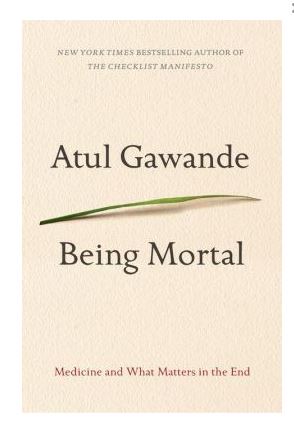
If you follow this blog, and you are a human being (based on double-digit traffic numbers, I suspect that some of the 2,000+ followers are bots, spiders or other web crawlers), I have to recommend a book: Being Mortal by Atul Gawande. He is a surgeon in Boston, well-known writer about all things medical, and has turned his mind to the issue of death and dying. I tore through this book in a day. Then the next day, I read it again.
It captures so many of my thoughts about what I hope and wish for my father. As a Sandwich Generation dad, it also made me think about how I will someday talk to my children about what I wish for and what fears they will be harboring. At least, I hope I get to have that conversation with them on my own terms.
I’m not going to clog up a blog post with a review of the book; others more capable than I have written those already. So instead I will leave it with this: if you have an elderly parent, drop what you are reading (unless it’s ‘The Martian’ – in that case, finish it and read this one next) and pick this up instead. Then pick it up again.
The Senior Moment

So Sophie bounds downstairs one morning last week, ponytail bouncing, and carrying a pair of underwear. She stops at the entrance to the kitchen and looks down at her hands as if in disbelief. Then she scrunches her face, and says “These aren’t socks. I meant to bring socks.” She turns around and heads back upstairs.
And in my mind I think: senior moment.
It was gratifying to seeing it happen to someone so young. Increasingly I find myself heading for the freezer and midway having to stop and remember what for. My father suffers from this almost less than I do; he has eliminated most clutter from his brain space so while (like the rest of us, let’s be honest) he repeats stories, usually he doesn’t find himself mid-stride without quite recalling why. And he remembers elements of his own childhood, and mine, with precision that’s almost startling. A few weeks ago I mentioned a childhood trip to the Outer Banks and he replied, “That was either 1973 or 1977.” He recounts details of his escape from Hungary almost 60 years ago like it just happened.
A while ago I wrote about feeling most times in this Sandwich Generation father experience that the glass half full. It’s true. The glass is half full any day when your 12 year-old daughter appears a little more forgetful than your 91 year-old father. Even more so when you make it to freezer without stopping to wonder why.
The Observation

Because it’s mid-Yom Kippur and I am in the part of the Sandwich Generation with only one parent, I am thinking about my mother today. Last night at services I looked to my right at my children and flashed briefly to just how much they’ve grown in the 4 years since she passed away. If she could observe them, she’d be proud of them. Maybe she would be a little proud of how I’ve done as a father with, let’s face it, no formal training whatsoever.
Over the choir’s chanting, I flashed to a recurring dream I’ve had over the past couple of years. I am a recurring anxiety dream kind of person. My usual standards are (a) I’m trying to make a plane but every step just seems to take a lot longer than usual, like I’m running in molasses, (b) I somehow didn’t study all semester and the test is in 24 hours or, another variation on this topic, (c) I’m back in business school and skipped most of last semester, so this semester I am really in trouble if I want to graduate. Oddly, I recently conquered (c); somehow mid-dream I’ve been remembering that Stanford was a zillion years ago and that this can’t be reality.
In this particular dream, I’m standing in the a dream-altered version of the kitchen of my childhood home. It is smaller, more cluttered (which you would not think possible if you ever visited my mom’s kitchen), the light a little more slanted and muted. My mother is alive. Her death turns out to have been a big medical mistake and she’s back. In the dream this is reality, not realization; as I walk into the house, I accept that this new version is just how things have been for some time now.
“Reality” also means that my father has moved back in with her into my childhood home and they have fallen back into the pattern where as a unit, she is caring for him.
I think I flashed to this because having pondered how proud my mother would be of her grandchildren, I know she would be amazed at my father. It’s hard to remember the days before he became a widower and in his late 80’s managed not only to survive but to carve out a life. But in the dream and last night in the synagogue, I realize that if she were still alive and could see it, it of course wouldn’t have happened. By observing it, she would change it. It’s the human application of the Heisenberg principle from physics: observing momentum at the atomic level alters it.
In the case of my parents, this maxim holds. My father told me a story a few weeks ago about a planned Alaskan cruise that they canceled abruptly the morning of their flight to Seattle because she suddenly didn’t feel well. Around and observing her constantly he didn’t divine what I surmised not long after she passed away: she spent the last several years of life struggling with illnesses, with anxiety, suffering in near silence. It was just like her to make you worry more about her more by telling you not to worry about her. Now, with distance, he recognizes that she must have spent weeks fearing having to let on to him that she wasn’t well enough to make that trip. Which then altered what happened.
As a caregiver, observation frequently leads to corrective action. It has to. As a parent, there is a balance is between observing our children’s reality and stepping in, no matter how good the intentions, to change it. Knowing when to do which is something for which, as previously mentioned, I did not receive formal training. I must have skipped that semester at Sandwich Generation dad class. Now as in my dream, I suppose I am in some trouble now as my daughters edge closer to adolesence. At least now I know to watch out for doing both at the same time.
The Moment

My brother and family visited from California last weekend. Traveling is challenging for them with a 6 year-old, a 3 year-old, a 6 hour flight and 3 time zones. But because my father lives here and is no longer mobile enough to travel, they make at least one journey east every year. This year the calendar page for September 13th said “Rosh Hashanah”, and thanks to a lucky series of sports scheduling and well-played tennis by Roger Federer and Novak Djokovic, it also marked the US Open men’s final.
When I was growing up, my father, brother and I would watch Wimbledon and the US Open religiously. My father would yell at the TV and criticize the players for all of the “stupid” things they were doing. It was a variation on a common theme in my house. Anyway, if I close my eyes I can imagine Borg and McEnroe when I was 10, or Steffi Graf and Martina Navratilova when I was 18, or 1996 Graf-Vicario final we watched in Atlanta while visiting my brother. And I remember watching the French Open with the 2 of them when my father was in the hospital in Princeton beating back post-colonoscopy complications when he beat colon cancer.
So in August this year, when I noticed how the calendars lined up, I started rooting for a #1 vs. #2 matchup at the US Open. And then the players in the rest of the draw acceded to my wish and it happened. It was as though destiny had one more epic tennis-watching session in store for the 3 of us. My kids, who I have indoctrinated into becoming Federer fans, were ready as well. My Sandwich Generation dad moment in front of the Flushing Meadow court.
Except that a rain delay pushed the match back from 4pm to almost 8pm, late enough that my father couldn’t watch with us, we had to serve dinner instead, and my kids were occupied with my nieces. It was a moment that was not to be.
I mention this because my kids have moved into pre-teen mode and I can hear the clock ticking down their last few days as willing inhabitants of our home. My father likely doesn’t have many US Open finals left in him. The moments I have together with them take on a fierce urgency, each opportunity feeling more precious than the ones before it. This is the benefit of mortality, I suppose. It forces you to appreciate and savor the glimmers you get.
This is one reason that, unlike my brother, I am not a frequent videographer. Maybe this is a mistake. My philosophy is that I would rather be in the moment than observing it, and I have learned about myself that I don’t do both well.
Most moments I have with my father now aren’t scripted calendar-aided events. Yes, my kids have their B’Not Mitzvah celebration coming up and with any luck he’ll be there. But I am thinking of the pauses amongst the list of chores I perform at his place when he stops, thinks, and begins a sentence with “You know, I never told you….” It’s not the notes that make the moments. It’s the empty spaces between them. The same goes for my kids. It’s the small remarks, the impromptu dances they choreograph, the stories they offhandedly tell us when we’re playing cards and everyone has their guard down. Those are the moments I already miss.
I checked with Google and learned that Rosh Hashanah 2016 is in early October, so there’s no US Open final during the holiday. Maybe it’s just as well. The 3 of us missed watching a pretty compelling final, but we’ll always have the 4th set tiebreak of the 1980 Wimbledon final. A great moment that, at the time, we didn’t see coming.
The Imperfection
When Bobbi Carducci of The Imperfect Caregiver asked me to contribute a post to her blog (where this entry also appears), I settled early on a topic that has been much on my mind recently. Then, suspecting it might send some readers running for the exits, I decided to check my instinct by asking my Facebook friends about particularly unappealing cocktail party discussion topics. Their list included pap smears, what sub-department of finance someone works in, minutiae-filled marathon training and post-run recovery rituals, CrossFit (described as the Amway coffee chat of the 21st century – by the way, Amway was on there too), someone’s latest airline travel delay nightmare, detailed hole-by-hole recounting of a round of golf, and fibromyalgia.
Included on this list, indirectly, was incontinence. Unfortunately, this is actually what I am writing about. But hang in there with me anyway.
My father is about as physically bulletproof as a 91 year-old can be. He is independent, sharp, strong, and mostly mobile. However, what he is not is able to do is control his bladder. It controls him. Back in 2002 when he weighed 50 pounds more than he does now, he had congestive heart failure, for which he was prescribed Lasix. If you don’t know what Furosemide (that’s the generic name) does, it’s a so-called loop diuretic, meaning it tricks your body into squeezing more water out of you. Kimberly-Clark, the company that makes the adult diapers Depends, should send their manufacturer royalty checks. Then he’s on Flomax (aka Tamsulosin), which relaxes enlarged prostates. In other words, it also eases the flow of urine.
Maybe Depends should be sending royalty checks to these guys as well.
Compounding the problem is that he is now only mostly mobile. So, reaching the bathroom when the urge strikes sometimes just takes too long. Who among us has not reached the bathroom with mere seconds to spare? He loses those seconds to slow movement. When you live in a community like he does, this causes complaints from other residents, which is a big headache.
His physically slowing down also affects the often-recommended solution of using Depends: he physically has trouble putting them on and taking them off. That assumes my brother and I could convince him to wear them, which we can’t. And honestly, I almost don’t want to succeed.
I’m oversharing about my father’s incontinence because I have to deal with it and at times, it dominates my discussions with him. With time to reflect, I realize how insane this is. He is a whole human being, a man in full, and this is an imperfection. This is a man who remembers stories about family members, friends and me, a history that will die when he does, and this is what I’m spending our time together talking about? How much to cut back his Lasix by? Whether or not to try out Oxytrol (a female hyperactive bladder medication) as a solution?
As caregivers, however, we frequently focus on the imperfections. They are the urgent we tend to rather than the important. It’s a peculiar byproduct of being in a caregiving position. Put another way: I have a good friend my age who has related issues, and I promise you, we have never discussed Oxytrol.
We also tend to obsess on the imperfections in how we provide care, whatever form that takes. As a Sandwich Generation father, I find often myself evaluating and second-guessing how I provide for, communicate with, and otherwise help raise my children. I even write an entire blog about it.
In the end, however, what matters is not the imperfections but the thing in full.
As I mentioned, I want to thank Bobbi for the chance to guest-write on her blog, the title of which I have a new appreciation for. Sometimes writing about imperfections in others and in ourselves, helps put them in the right perspective. I know it has for me.
The Sweet Tea

Many of my childhood summer family vacations consisted of too-long family truckster car trips to unglamorous destinations where my father had secured a consulting project. He worked on cable TV systems, the “head-ends” for which are usually on the outskirts of sleepy towns where, I am confident, most Americans do not vacation. Utica, NY. Gadsden, AL. Charleston, WV. Houma, LA. Midland, MI. I’m sure these are perfectly nice places to live – but once you’ve seen one Days Inn motel room, you’ve kind of seen them all.
Usually my father drove and my mother sat in the passenger seat. We’d load most of the suitcases into the middle of the station wagon, and then my brother and I would inhabit the “way back”. Sometimes we would climb over the piled suitcases in the mid-section and get horizontal as we cruised down I-95.
This was in the days before iPads and built-in DVDs, so on our drives from home in Lawrenceville, NJ to Commerce, GA (our frequent first stop when heading south), we had to amuse one another. When we got thirsty, we’d ask my mother for a cup of iced tea; she’d dispense a cup from the cooler that she’d filled that morning with an ample supply of Shop Rite’s own brand of powdered, sweetened iced tea.
This image came to my mind in a flash the other day when I found myself behind the wheel on the New Jersey Turnpike, Nova to my right, the kids in the back seat, on our first-ever road trip as a family. We are in the Outer Banks, so it’s not quite Meridian, MS, where I did once spend a few days at what I think was a Rodeway Inn. But it was eerie just the same. The familiar buzz of the highway flying past, the blinking white lines in the middle of the road, the faded Stuckey’s billboards and constant lookout for radar trips all only added to the sensation.
About 300 miles later, we crossed the Chespeake Bay Bridge tunnel. It’s a long stretch through Virginia and then out of nowhere, you are flying across the Chesapeake. My kids had the same experience I did the last time we crossed it as a family almost 40 years ago: sheer boredom followed by 20 minutes of wonder. My father was driving, of course. It is strange to think of him as so in command, which back then was all I knew of him. A confident man in command.
My kids certainly have the sensation in front of them as well of discovering how fragile their father really is
As a circle of life moment, that flash on the New Jersey Turnpike is a minor one in the life of a Sandwich Generation father. The sweet tea memory is a mundane one, in some ways. But then I suppose that those are the ones that sneak up, and stay with you.


 The Sandwiched Man
Recent Comments